The pull request that knows its sessions
When agents write most of the code, a pull request is the end of a conversation you were not in. Codecast keeps the two attached: every PR carries its checks, its reviews, and the sessions that made it, and a review can wake the agent that owns it.
The diff is the least interesting part
A pull request used to be a person's work, summarized by that person. You read the description, you knew who to ask, and the reasoning lived in their head a desk away. When an agent wrote the change, the description is the agent's, the reasoning is in a transcript, and the person whose name is on the PR may have steered it in ten messages and read none of the code. The question a reviewer actually has is not “what changed” but “what was this agent trying to do, and did it check”. GitHub cannot answer that. The session can.
So codecast treats a pull request the way it treats a session or a task: as an object with an address, a state, and links to the conversations around it. Here is the team's open list on our own repository this morning:
$ cast pr ls --repo codecast-sh/codecast
  #46  open  Artifact draft store: published pages can autosave vi-  aivery/artifact-drafts -> main        10 green 2 red  1h
  #47  open  fix(cli): a Mac remote absorbs the pushed Claude logi-  remote-mac-credential-absorb -> main  9 green 3 red   jx7905c  1h
…  three more rows: two webhook test PRs and a proof PR  …
Two teammates, two branches, check counts, and on the second row a session id: the conversation that pull request belongs to. That column is the whole idea.
Everything known about one
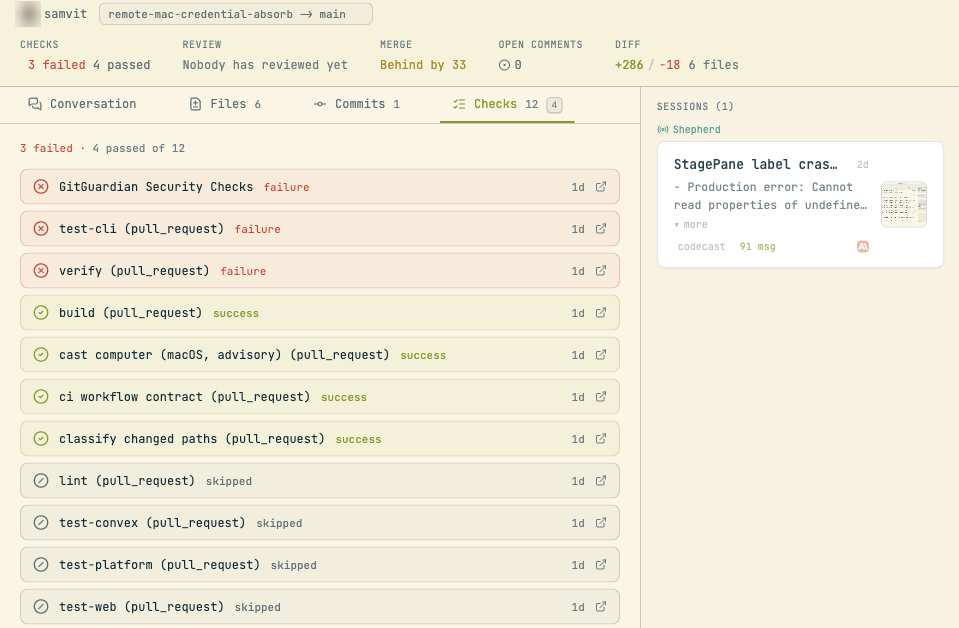
cast pr show is the page a reviewer wants before opening the diff. State and merge status, the author, which session shepherds it, every check with its verdict, the open comments, and the sessions linked to the change. This one, from a teammate, is shepherded by a session about a crash and linked to six more:
$ cast pr show codecast-sh/codecast#47
codecast-sh/codecast#47 fix(cli): a Mac remote absorbs the pushed Claude login into its keychain and never rotates it open

  url        https://github.com/codecast-sh/codecast/pull/47
  page       https://codecast.sh/pr/codecast-sh/codecast/47
  branch     remote-mac-credential-absorb -> main
  sha        e7a03055c5cc
  author     samvit
  merge      unstable, 33 behind
  updated    1h ago

shepherd
  session    jx7905c StagePane label crash fix
  enabled    no

checks (failure)
  x GitGuardian Security Checks failure
  * classify changed paths (pull_request) success
  - lint (pull_request) skipped
  …  seven more checks: build, the contract check and an advisory macOS check pass; four jobs skipped  …
  x test-cli (pull_request) failure
  x verify (pull_request) failure

unresolved comments (3)
  samvit  ## 🎙️ Codecast Conversation
  …  one bot comment  …
  samvit  Rebased onto origin/main (e7a03055c). Note for reviewers: `daemon.machine-prompt

linked
  jx7905c StagePane label crash fix
  jx7cep7 Verify Codecast E2E
  jx71rq4 Keyboard shortcuts help coverage
  jx7fmc6 Verify codecast cross-machine
  jx724wf Mobile viewport scaling fix
  jx71196 React error #520 debug
  jx73db1 Task status picker
Seven linked sessions, judging by their titles: a crash fix, two verification passes across machines, a React error debug, and three unrelated to the change that read or touched it. Each is one cast read away, and in the web app they sit beside the PR as cards. The first unresolved comment is titled Codecast Conversation: a link from the pull request back to the session that made it. The paper trail runs both ways.
The same object in the web app, on the Checks tab, with the shepherd session in its own panel to the right:
A timeline, not a notification pile
GitHub tells you a check failed by email, one at a time, out of order. Codecast keeps the pull request's history as a timeline you can read top down, and cast pr watch streams the same events live, one line per change, silent until something moves:
$ cast pr events codecast-sh/codecast#47
    8h pr_behind PR #47 is behind main
    1d pr_check samvit CI failed: verify (pull_request)
    1d pr_check samvit CI failed: verify (pull_request)
    1d pr_check samvit CI failed: test-cli (pull_request)
    1d pr_ready PR #47 merges cleanly again
    1d pr_check samvit CI failed: GitGuardian Security Checks
    1d pr_synchronize samvit PR #47 updated to e7a0305
    1d pr_check samvit CI failed: test-cli (pull_request)
    1d pr_behind PR #47 is behind main
    1d pr_check samvit CI failed: GitGuardian Security Checks
    1d pr_opened samvit Opened PR #47: fix(cli): a Mac remote absorbs the pushed Claude login into its keychain and never rotates it
Read it bottom up and you can see the day: opened, a security check and a test job fail, the branch falls behind main, the author pushes a fix, the PR merges cleanly again, the same two checks fail again, a third joins them, and by morning it is behind main once more. That is a pull request waiting for its owner. Which brings us to the part that is new.
A review that wakes the author
When a session owns a pull request, codecast calls it the shepherd. Turn it on with cast pr shepherd on, or let the shipping flow do it when it opens the PR. From then on the session is woken when the pull request moves: a check goes red, the branch falls behind, and above all, someone reviews it.
$ cast pr comment 47 --hold --file src/x.ts --line 42 "what should change here"
$ cast pr review 47 --request-changes -b "one fix, then good to go"
A review from the shell is a batch: hold notes on lines, then send them as one verdict. It lands on GitHub under the reviewer's own account, so the verdict is theirs. And if the pull request has a shepherd, the whole review, verdict and every note, arrives in that session as a message the moment GitHub accepts it. The agent that wrote the change reads the review, makes each fix, pushes to the same branch, replies on the threads it addressed, and resolves them. The reviewer sees resolutions, not silence.
The shepherd on our example is off, which is why it sat behind main all night with three red checks and nobody woke up. Toggle it on, and the next failed check becomes a turn in the session that knows the code.
Why this is a team feature
Every previous post on this blog was about one person's agents. This one is about the seam between people. A pull request is where a teammate first meets work they did not watch happen, and the question they bring is always the same: what was the agent trying to do? Linking the PR to its sessions answers it without a meeting. Letting a review wake the agent answers the follow-up, “who fixes it”, without a person relaying comments into a terminal. The record that made a session searchable last month is the same record that makes its pull request reviewable now.
Codecast is where your team sees, steers, and remembers every coding agent session — any agent, any machine.
The three terminal captures are genuine cast pr output from 2026-09-17 against the public repository codecast-sh/codecast, whose pull requests and author handles are public on GitHub. The ls excerpt keeps two of five rows; the show excerpt drops the per-check URLs, collapses seven checks to one line, and omits one automated bot comment. Each omission is marked …. The review commands are illustrative, with placeholder file and text, and were not run against this pull request. The screenshot is the pull request page in the codecast web app, cropped to the content column from the author row down; the author's avatar is blurred.