One queue for the decisions your agents need from you
When an agent hits a fork it cannot settle alone, it writes the question, the options and its reasoning into a card. The card waits in Questions, in the app's sidebar and on your phone. You clear the queue when you choose to, a key per answer, and each answer goes back to the session that asked.
Nothing has written to it in 40 days and no query reads it. A drop is recoverable only from a backup restore.
Both pass review. Sentences read clearer and make each row about a line longer. I am carrying on with labels.
The worker retries every 30s. A 10 minute outage at the provider sends 20 retries per event and trips their rate limit.
Jitter spreads the load but can hold the first good delivery back by up to 4 minutes.
- Retry webhook deliveries
- Settings page copy
- Retire agent_runs_v1
Three ways an agent can handle a choice it cannot make alone
It can stop and ask, which pulls you out of your own work to read a transcript. Or it can pick alone, and you find out after code depends on the choice. Codecast puts the question in a queue instead, and the agent asks only what is yours to answer: everything else it decides and reports.
What the agent puts on a decision card
One question, 2 to 9 options, and the reasoning: what it found, what each option costs, and why it cannot pick. Each option carries its consequence under its label, so you compare outcomes where you click.
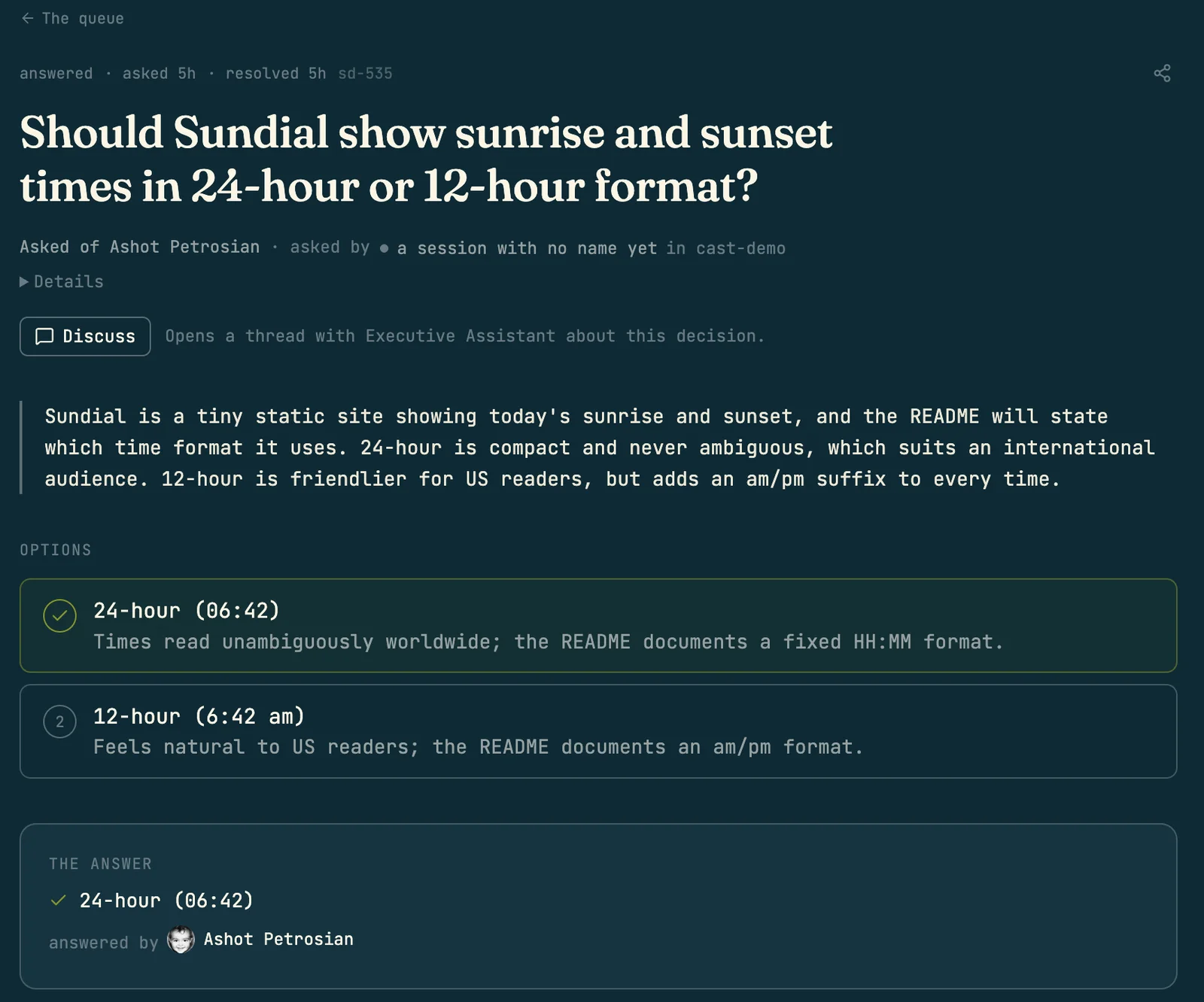
- The questionone, in large type, so you know what you are deciding before you read anything else
- The reasoningwhat the agent found, and why it cannot pick alone
- The options2 to 9, numbered for the keys, each with what happens if you choose it
- The evidencea report, a page per option or a long document, when a paragraph is not enough
- The answera click or a number key, or Or answer in your own words
Blocking and advisory asks
Blocking is the default: the agent asks and stops, and the session shows Waiting on your decision until you answer. An advisory ask names a default and the agent carries on with it, while your answer can still override it.
The session is waiting on your decision. The queue opens it as the full sheet, and it sorts to the top while the session can still take an answer.
The agent keeps working on its default. In the session view the ask folds to one pill above the composer, so the thread stays the main event. It sorts after every blocking ask in the queue.
The agent can turn an advisory ask into a blocking one, which clears its default. A blocking ask never answers itself; only an advisory member of a stack with an Auto default does.
Attaching evidence to a decision
A decision that deserves proof gets a page. The agent can attach a report that renders under the question, give each option its own page so two designs sit side by side, or attach a long document.
Each option page opens full size from the card. A report or page can be one the agent built for this question, or a page already published in codecast.
Beyond one choice, an ask can take several options, an order, a short form, or one line of text. Each option can also carry its cost, risk and links to evidence.
Clearing the queue, and the order it follows
Questions in the sidebar counts what is waiting on you and opens the queue as a list; one at a time walks it as full cards. The order follows a fixed rule. Blocked asks whose session can still take an answer come first. Blocked asks on a stopped session come next. Advisory asks come last. Inside each group the oldest is first, because a parked agent costs more the longer it waits.
An answer marks the row answered at once and sends a normal user message into the asking session, Decision: <label>, rendered as an answer linked back to the ask. An answer given from the command line writes the same message. The first answer wins; a second one changes nothing.
A permission prompt and an agent's terminal question wait in the same queue. On a permission card the digits are off and only y and n answer, so a digit meant for the previous card can never approve something.
The phone app walks the same queue one decision at a time, and moves to the next one when you answer, skip or dismiss.
Stacks of related decisions
A stack groups related asks, like everything a launch needs from you, into a checklist with an id such as ds-7. An agent can build one as it asks, or you click group into a stack in the list, tick the cards and name it.
- Ship the pricing banner on Monday?
- Which plan is the default on signup?
- Send the launch email to the waitlist?1Send Tuesday 9amthe copy passed review on Friday2Hold a weeklands after the docs refresh
- Annual toggle on or off by default?
- Keep the free tier's 3 seat cap?
- Due. Set on the stack's page: when you mean to clear it. Overdue stacks sort first.
- Auto default. After that many hours, advisory members are answered with their default. The checklist also answers them all at once.
- Keys. 1 to 9 answer the current member, n and p move between them.
- Delegate to a role. Hands the stack to a role, which answers every open category for its members. Protected questions still come to a person.
- Done. A stack closes when every member is resolved: answered, dismissed or withdrawn.
Editing or withdrawing an open ask
A posted decision belongs to the agent. When the facts change it rewrites the card in place, keeping its age and its spot in your queue. When the question stops mattering it withdraws it, and the conversation shows the ask as withdrawn.
The reasoning now says the web index already moved to path ids, so only the daemon is left to change.
It leaves your queue, and the transcript keeps the ask with its withdrawn mark.
What an agent should and should not queue
Switching on Decision queue in Agent features teaches agents where the line is: a card is for an answer that is genuinely yours, and every other choice the agent makes itself and says what it chose.
- What you intendwhen nothing written settles it
- A fact only you holdnothing in the code, the docs or past sessions says
- Money beyond its budgetspend the run was not given
- An irreversible change that reaches manya mistake people outside the work would feel
- ×Anything more reading answersthe code, the docs or past sessions already say
- ×An answer already givenan earlier card, a ruling or the project's instructions settle it
- ×Removing data the system rebuildsor that exists to be thrown away
- ×A status updateprogress goes on the task
- ×A probe, a test, a layout sampleevery ask reaches your real queue and phone
Commands for scripts and agents
Agents ask through the cast decide command, and anything on this page can be scripted with it. cast decide --help and cast stack --help print the rest.
cast decide "<q>" -o "A :: why" -o "B"Ask one question with 2 to 9 options; text after :: is the consequence--context <md> | --context -The reasoning, in markdown; - reads a heredoc--report <file>Publish an HTML or markdown page and embed it under the question--option-page n=<file|slug|url>A page for option n--doc <file>A long markdown body; the card links to the decision page--advisory --default <n>Keep working on option n; the answer may override it--kind single|multi|rank|form, --line <label>Ask for one, several, an order, a form, or one line of text--card <card.json>Ask about a change card; without -o the options are Ship, Revise, Drop--stack ds-N · --task ct-N · --to @handleAppend to a stack, bind to a task, address a personcast decide ls [--mine]This session's asks with ids, answers and stalenesscast decide edit [id] [flags]Rewrite the open ask in place; --blocking clears the defaultcast decide cancel [id]Withdraw it; the conversation shows it as withdrawncast decide show <sd> · answer <sd> <n>One decision in full; answer from a shellcast stack create "<title>" [--policy auto-default:24h]Start a stackcast stack add | remove | reorder | show | lsShape and read stackscast stack policy ds-N --due <when> | --auto-default <dur>When you mean to clear it; when advisory members defaultcast stack delegate ds-N @handleA role answers every open category for the stack's membersLimits and questions
The parts people ask about first.
Related features
An answer that should run work later: arm a trigger from the session that got it.
Workers you spawn ask through the same queue, so a fan-out reaches you as one sitting.
A finished change can come to you as a card that asks Ship, Revise or Drop.
The reasons behind a decision stay searchable, so the next agent starts from them.
Get started with decisions
Install codecast, open Agent features from your account menu and switch on Decision queue. Your agents learn when to queue a choice and how to write the card, and the queue waits in Questions on the web, the desktop app and your phone.
curl -fsSL codecast.sh/install | shbrew install codecast-sh/tap/codecast or npm install -g @codecast-sh/cli