Your agents forget. Your team doesn't have to.
Every agent session is a problem being solved out loud, and then the terminal closes. Codecast keeps the record searchable — so the next agent, or the next person, starts from the answer.
The most expensive thing an agent produces is thrown away
Watch an agent work on a hard bug and most of what it produces is not code. It is the investigation: the three hypotheses it ruled out, the file it read that turned out to be the culprit, the one-line experiment that proved it, the sentence where it finally says found it. Then the fix lands, the session ends, and all of that goes with it. The diff survives. The reasoning does not.
On a team this compounds. Someone else hits the same wall next month — or the same person does, in a fresh session with no memory of the last one — and an agent starts the whole investigation over from zero. The answer already existed. It just lived in a terminal that closed.
One real question
Here is a session from this repository, one week ago. The prompt was one line: why is my seo so bad — we don't even rank for codecast. Twenty-six messages later the agent had the root cause. Codecast recorded the session as it happened, so today it is one query away. From the terminal:
$ cast search "Googlebot blank page"
Found 30 matches in 10 conversations
── CodeCast SEO backlink campaign ──────────────────────────
jx7c9d2 | yesterday | 465 msgs | ~/src/codecast
edits: packages/web/src/compat/tabRouting.ts, packages/web/package.json, packages/web/scripts/indexnow.mjs +5
1: [assistant] ... it. Your SEO is bad for one dominant, fixable reason: **your own server serves Googlebot a blank page**. Everything else is secondary.
## The root cause
`packages/web/server/bot-meta.ts` is a link-unfurl middleware built so Slack and Twitter cards look nice. But `Googlebot`, `bingbot`, and `Apple...
2: [assistant] ...ss="seo-grid">
<div class="seo-card"><h4>Before</h4>
<div class="bad">Googlebot got <b><body></body></b> on every page</div>
<div class="bad">robots.txt and sitemap.xml returned the SPA shell</div>
<div class="bad">9 of 14 marketing pages had title "codecast"</div>
...
3: [assistant] ...e in prod.** The prerender commit (`eaa0e6285`) is on origin/main and deployed: Googlebot now receives 86KB of real HTML from codecast.sh with an `h1` and the new title, `sitemap.xml` serves as genuine XML, and robots.txt is up. Google's index just hasn't recrawled yet ...
… 9 more conversations
The first hit is the diagnosis itself, with the sentence that mattered right there in the excerpt. Search runs across every session on the team — yours and your teammates' — and matches message content, not just titles, so a phrase the agent said in passing is enough to find the session that said it.
The same query in the web app, with the filters that scope it: everyone or only you, everything or only your prompts, a time window, and sort by recency or relevance:
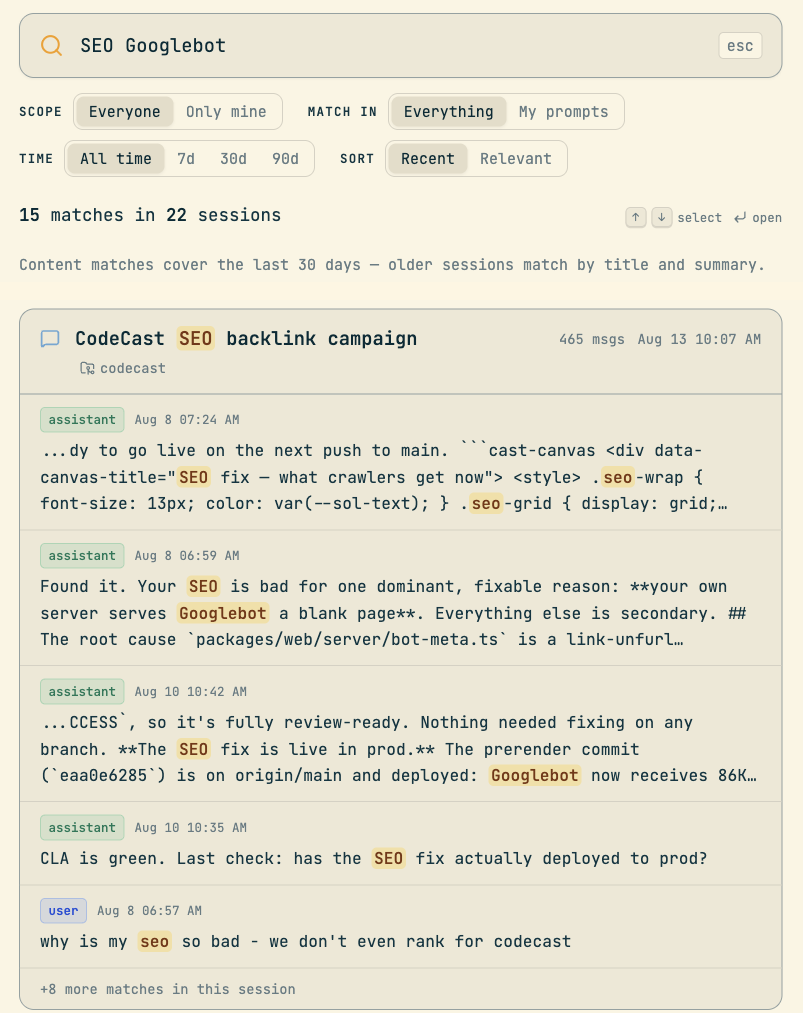
Read that card bottom to top and it is the whole arc: the question, the diagnosis two minutes later, the deploy confirmation two days after that, and the loose end (has the fix actually deployed to prod?) that came up in review. That is what a session record looks like when it is kept.
From a hit to the whole story
A search result is a pointer. Three commands turn it into understanding, each one a step deeper. cast summary gives you the shape of the session — goal, approach, outcome, files touched — the way you would ask a colleague “what happened there?”:
$ cast summary jx7c9d2
<SUMMARY session="jx7c9d2">
# CodeCast SEO backlink campaign

## Goal
why is my seo so bad - we don't even rank for codecast

## Approach
- Let me confirm what Google has actually indexed and glance at the marketing page metadata handling before I summarize.
- Your SEO is bad for one dominant, fixable reason: **your own server serves Googlebot a blank page**.
- Setting up a task and grounding in the server code first.

## Outcome
The Gamma playbook is implemented — every one of the 23 items is now either shipped, spec'd as a task, routed to your kit, or consciously skipped.

## Files Changed
- ~/.../lib/seoRoutes.ts (+5 -4)
- ~/.../src/prerender-entry.tsx (+5 -4)
- ~/.../public/robots.txt (+8 -0)
- ~/.../(marketing)/pageMeta.ts (+4 -3)
- ~/.../scripts/prerender.mjs (+4 -3)
…  4 more files
</SUMMARY>
cast read opens the transcript at any message. This is message 26 — the moment the agent found it — including the mechanism, which is the part a diff can never tell you:
$ cast read jx7c9d2 26
── CodeCast SEO backlink campaign ──────────────────────────
   jx7c9d2 | Yesterday | 465 msgs | ~/src/codecast

  26: [assistant]
       Found it. Your SEO is bad for one dominant, fixable reason: **your own server serves Googlebot a blank page**. Everything else is secondary.

       ## The root cause

       `packages/web/server/bot-meta.ts` is a link-unfurl middleware built so Slack and Twitter cards look nice. But `Googlebot`, `bingbot`, and `Applebot` are in its `BOT_UA_PATTERNS` list. When Google crawls any page, the middleware returns `ogHtml()` — a head full of meta tags and a literal empty `<body></body>`. I verified this live:

       ```
       curl -A "Googlebot..." https://codecast.sh/  →  <body></body>
       ```

       So Google's view of codecast.sh is: title "codecast", a one-line description, zero body text, zero links. …

       The unfurl middleware and SEO have opposite needs that got conflated. Slack and Discord only read `<head>` tags, so an empty body is fine for them. Google reads the body and follows links. One `isBot()` list treating both audiences the same means the feature that makes share cards pretty is the same feature that blinds Google. The fix is to split the list, not delete the middleware.

       …  secondary problems and the four-step fix trimmed  …
Notice what you now know that git log would never have told you: the bug was not in the SEO code at all. It was in a link-unfurl feature built for Slack, doing exactly what it was designed to do, for an audience it was never meant to serve. If you had inherited that repository and touched bot-meta.ts without this context, you would have had a fair chance of putting Google back on the wrong list. And cast diff jx7c9d2 lists the nine files the session actually changed, with --patch for the full diff — for the moment you need to see the code after all.
Agents remember through it too
The interesting part is who else can run these commands. Every codecast agent session gets the same CLI. An agent about to start a task can ask what came before it — which is exactly what cast context is for. We ran this while drafting this post:
$ cast context "add a new marketing page with SEO"
<CONTEXT query="add a new marketing page with SEO">
Found 10 relevant sessions

## Most Relevant
[jx7a9s8] 4:04 PM - "Codecast monorepo setup"
  Preview: ... checks run in both directions (`routes.manifest.test.ts:266`, `:317`, `:375`). Adding a manifest...

[jx7c9d2] Yesterday - "CodeCast SEO backlink campaign"
  Preview: ...dy to go live on the next push to main. ```cast-canvas <div data-canvas-title="SEO fix — what cr...

[jx76rg1] Jul 22 - "Codecast market positioning launch"
  Preview: ...f"> ct-39374 blog work is done and verified. Files (all under packages/web/app/(marketing)/blog/,...

…  7 more sessions

Use: cast read jx7a9s8 <range>  # read session messages
     cast summary jx7a9s8        # get session summary
</CONTEXT>
Ten sessions, ranked, with the two commands to go deeper printed at the bottom because the reader is expected to be an agent. It found the SEO session, the launch session that built the first blog pages, and the monorepo setup session that explains the route manifest checks a new page has to pass — three things a new agent would otherwise have had to rediscover by reading code, or worse, by getting it wrong once. Memory stops being something you have to remember to write down. Every session is already the note.
Whose memory
Search is scoped the way your team is. Sessions in a shared project are searchable by the whole team; sessions in a private project are searchable only by their owner. The Everyone / Only mine switch in the screenshot is that boundary made visible. Content matches cover the last thirty days in full; older sessions match by title and summary, so a session from March still surfaces by what it was about. Nothing is searchable that you did not choose to share.
A few weeks of running agents this way changes a habit. You stop asking a teammate “did anyone ever look at this?” and start asking the record — and the record answers with the session, the reasoning, and the exact message where someone, or something, found it.
Codecast is where your team sees, steers, and remembers every coding agent session — any agent, any machine.
All four terminal captures are genuine cast output from the author's account on 2026-08-15, and the session they point at (jx7c9d2) is a real session from the codecast repository, one week earlier. Excerpts are trimmed to the codecast repository; every omission is marked …. The screenshot is the web app's search page cropped to its content area, joined from two captures of the same results — the query header, and the result card for that session; one card between them, for the session that wrote this post, is left out.