Calls: decide it out loud, and the agents can quote you
Huddles transcribed with the speaker on every line, summarized with action items, and readable by any session.
A lot of engineering decisions are made on a call, and coding agents never hear them. Someone types a summary later, or nobody does. Codecast huddles are built into the workspace (channels, DMs and each session's own room) and transcribe while they run, with the speaker's name on every line. When a huddle ends it gets a title, a summary and action items, and any session can read it with cast call, cite the exact words, and turn what was agreed into tasks.
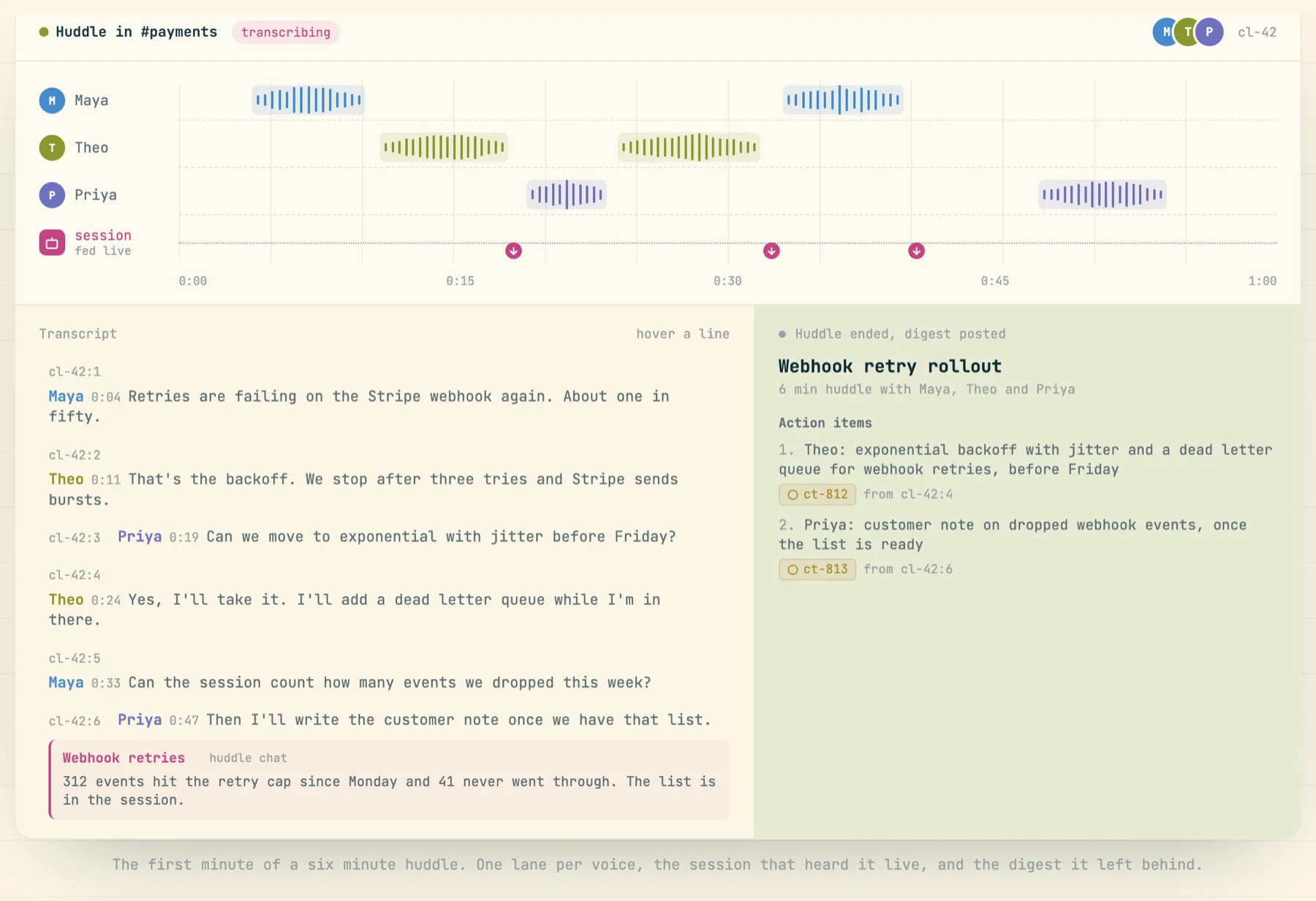
Every line knows who said it
Most meeting tools record one mixed stream and guess speakers afterwards. Codecast never mixes. One client in the room acts as the scribe: it holds each person's audio track and streams it to speech recognition on its own connection. A track belongs to one participant, so attribution is structural and there is no diarization step to get wrong. If the scribe's laptop closes, another client adopts the same run and the old one lets go, so no word lands twice. Each stored segment carries seq, speaker_id, speaker_name, text and times.
The digest lands where the huddle was held
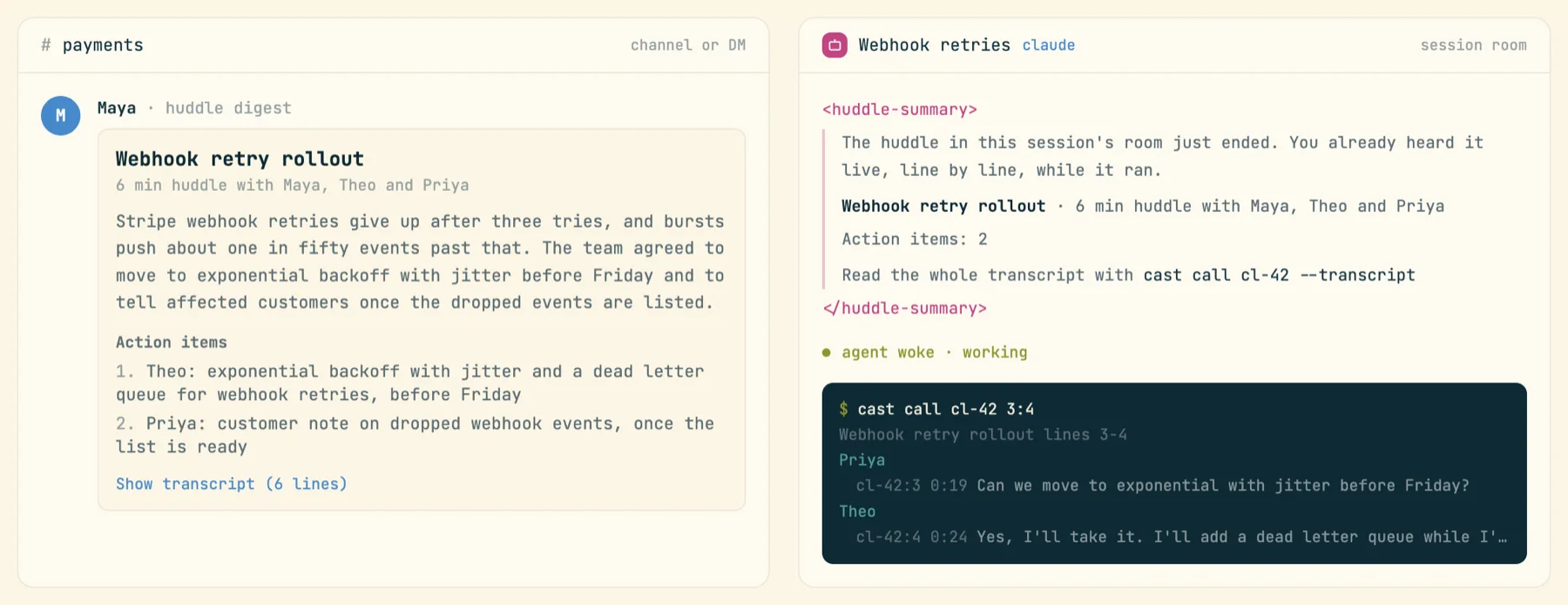
A huddle in a channel or DM posts a digest message there, transcript a click away. A huddle in a session's own room wakes that session's agent instead, with a short <huddle-summary> and the command to read the rest. The agent does not get the transcript dumped into its context; the words stay on the server until it asks. A huddle under 40 words gets no generated summary (its digest is the words themselves).
Any session can read it, and cite the exact words
A call is an object with a short id, like a task or a session. Every transcript line prints with the reference that cites it, so an agent quoting the call names the line and the person. cl-42 in a message renders as a live pill with the call's title, length and speakers; cl-42:3-4 alone on a line embeds those lines with their speakers.
$ cast calls
○ cl-42 14:02 6m  Webhook retry rollout
   Maya, Theo, Priya
○ cl-41 11:30 14m  Billing page review
   Maya, Sam
$ cast call cl-42 3:4
Webhook retry rollout lines 3-4
Priya
  cl-42:3 0:19 Can we move to exponential with jitter before Friday?
Theo
  cl-42:4 0:24 Yes, I'll take it. I'll add a dead letter queue while I'm in there.
Embed these words in a message: cl-42:3-4 on its own line
(Fixture output from the calls feature page; the real cast calls on this workspace lists teammates' calls, so it is not shown. cast call <id> --transcript prints the whole thing, cast call cl-42@12:34 the lines being said at that moment, and --json the segments.)
Action items become tasks that quote the call
The generated action items are a draft. The /cast-from-call skill reads the summary, checks every item against the transcript (who committed, to what, by when, and whether anyone pushed back later), drops what was only floated and adds what the summary missed. Each surviving item is filed with cast task create --from-meeting, assigned to the person who took it on, with their line quoted in the description. Tasks people agreed to on a call reach the human task board on their own.
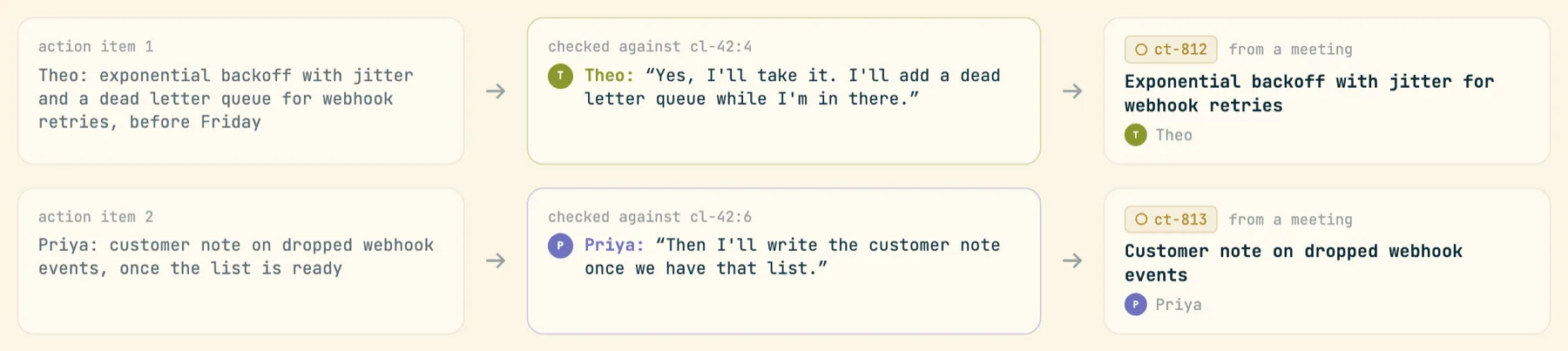
$ cast task create "Exponential backoff with jitter for webhook retries" --from-meeting --assignee theo -p high -d - <<'DESC'
Agreed on the call Webhook retry rollout (cl-42).
Theo: "Yes, I'll take it. I'll add a dead letter queue while I'm in there."
Due: before Friday
DESC
ok Created ct-812: Exponential backoff with jitter for webhook retries
Agents on the call
A huddle in a session's own room feeds that session live, so one person is enough to start a call: the agent is the second party. Any huddle can also be pointed at another session, a doc or a linked Slack channel. Words arrive each time the room goes quiet, on the same path as cast send. A line that names the agent goes through at once, even mid-turn; the rest waits until its turn ends. When the agent needs to concentrate it runs cast call hold 10m (up to 30 minutes per ask), and everything said meanwhile arrives together when the hold ends. The agent takes part in the huddle's text chat (its reply appears there as its own line, cut at 1800 characters with a link), and on codecast.sh it also gets a face: a video participant that speaks its replies and is marked as an agent on every surface.
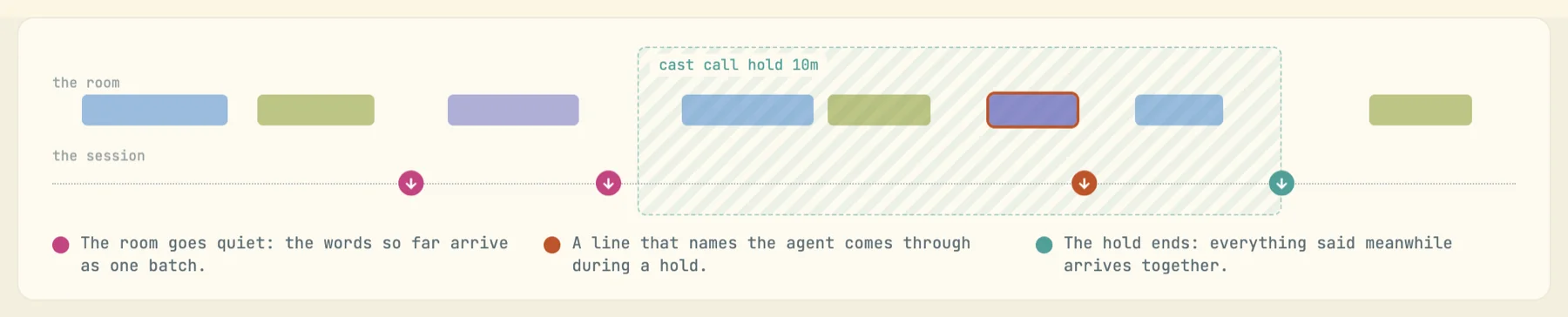
cast call hold: the room keeps talking, the agent keeps working, and only a line that names it interrupts.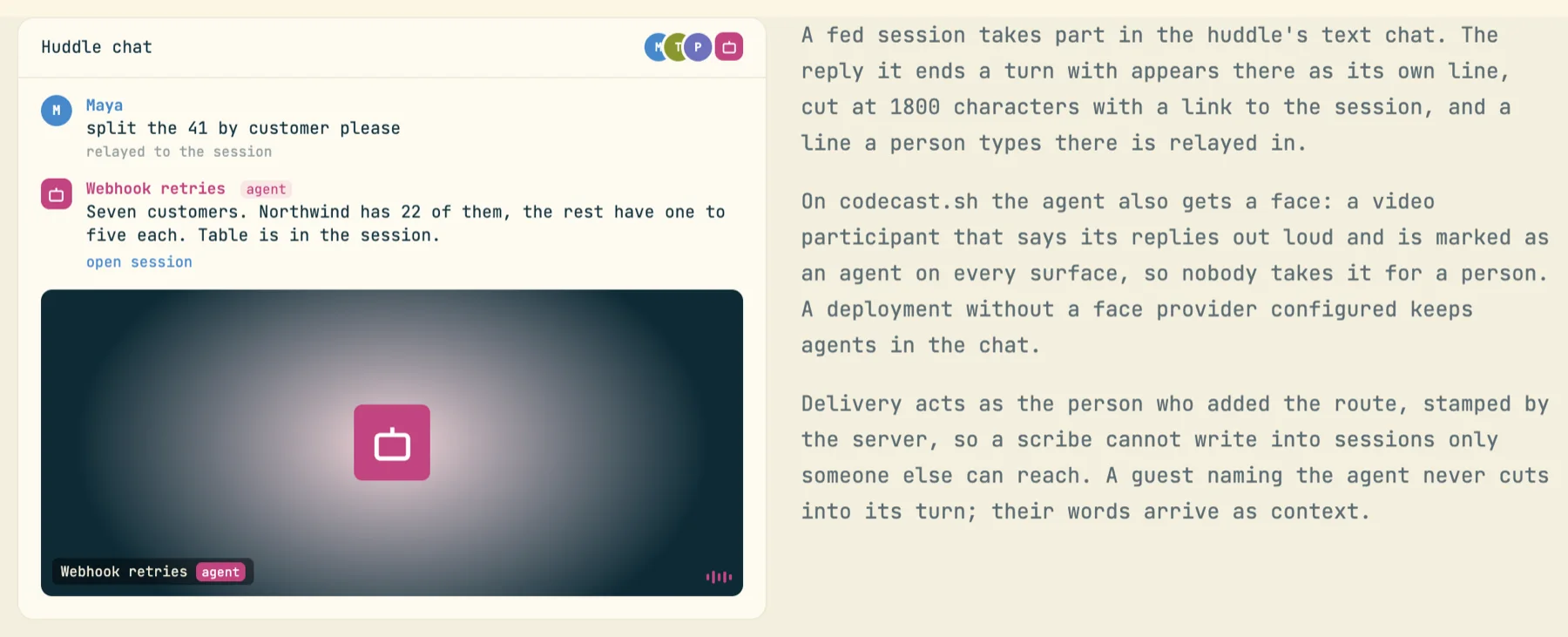
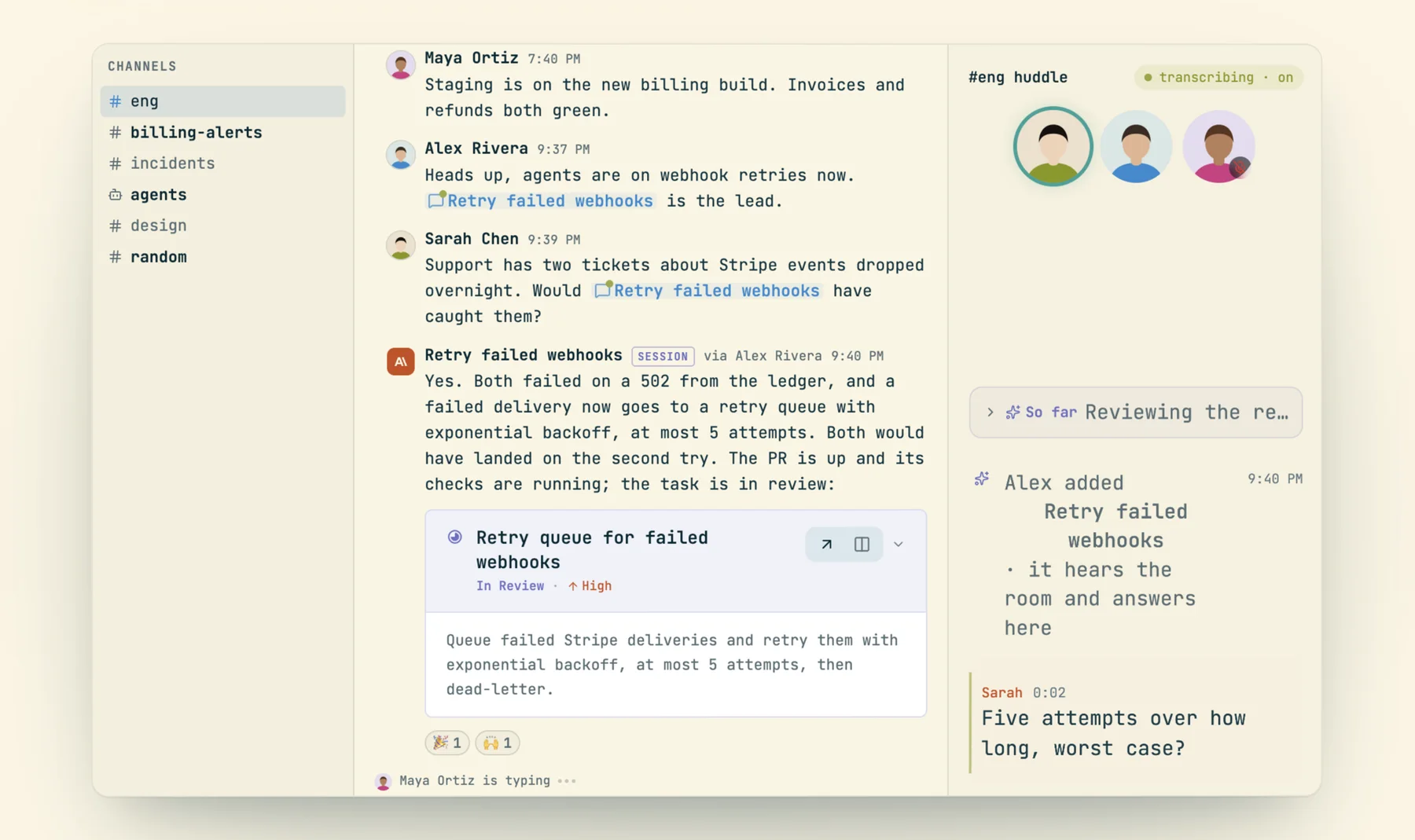
Recording is separate from transcription and never silent: only a press of Record starts it, everyone (guests included) is told, and it stops when no teammate is left. Screen shares are kept as their own full-resolution files, and cast call snap cl-42:4 pulls the frame from the moment line 4 was said, so an agent can see the code that was on screen. Calls are a team feature, off until an admin turns them on, and need a LiveKit server for the media.