Team memory and cast blame: every line sits on the conversation that wrote it
Every agent searches what every other agent learned, and cast blame names the session behind each line of code.
A coding agent starts every task cold. It reads the code, guesses at intent, and rediscovers what a teammate's agent settled last week: why the retry cap is 5 and not 3, why signatures are checked before parsing, which approach was tried and failed. The reasoning existed. It lived in a transcript on someone else's laptop, and when the session ended it was gone.
Codecast keeps every session your team runs, from any agent on any machine, and makes that history something agents and people can query. Four tools do the work: search by what a session touched, ask one session a question and get cited lines back, blame a line of code to the session that wrote it, and read the session id straight out of the commit.
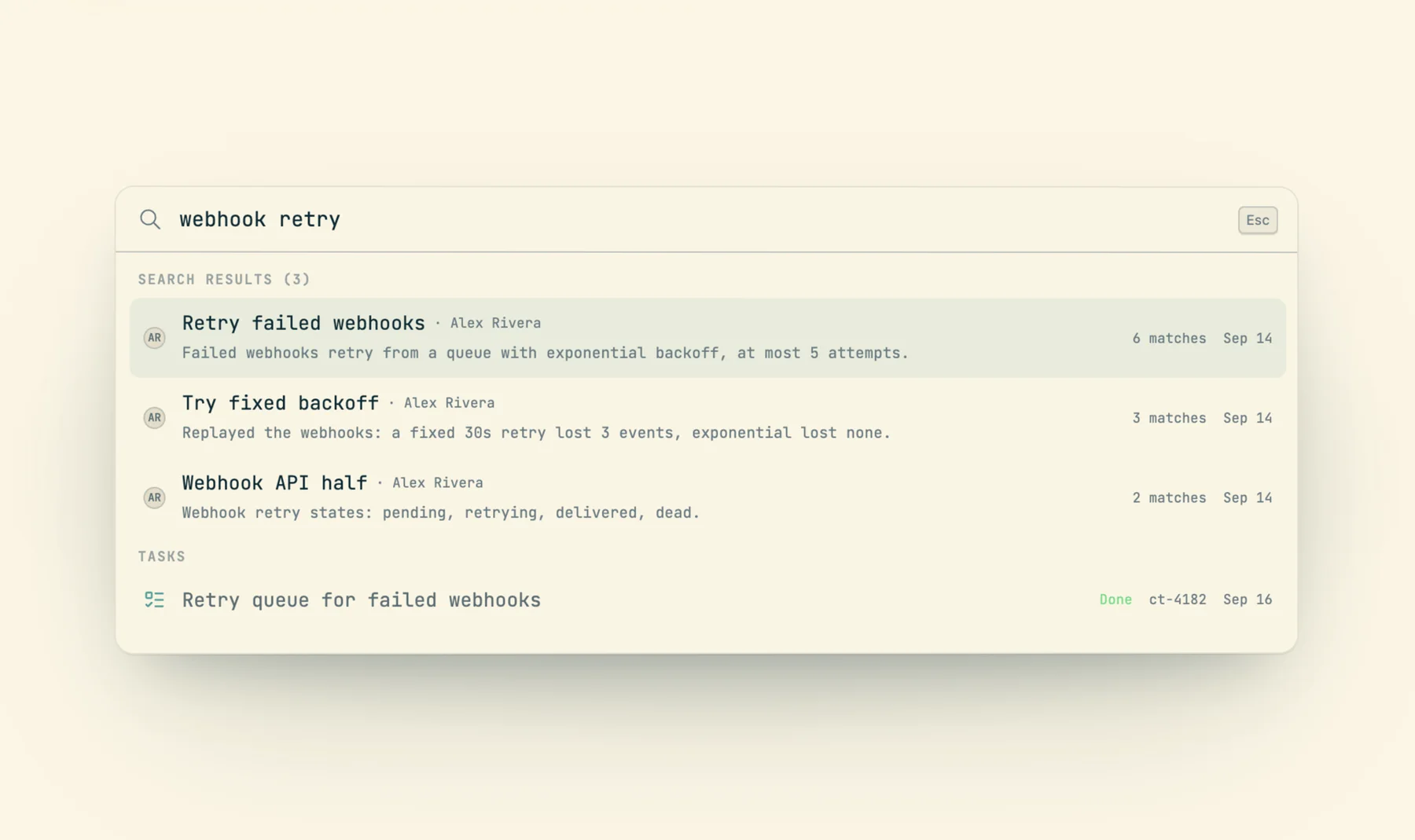
Search the work, not just the words
Every session records the files it edited, the commits it made, the pull requests it is linked to, the repository, who ran it and when. cast search turns each of those into an operator: file:, commit:, pr:, label:, author:, repo:, after:, before:. With no text, an operator lists the matching sessions, newest matching change first. With text, it narrows where the text is searched. The web search page reads the same query string.
So "which session made this commit?" is one command. Here it is against codecast's own repository:
$ cast search commit:5831cb2e2
Found 1 session matching the filters

── Crosshatch refinement ───────────────────────────────────
jx7bbz2 | ○ idle killed | 11 hours ago | 81 msgs | /.../worktrees/cloud-54e335
worktree cloud-54e335 · on Linux
edits: …/web/components/sidebar/navPrimitives.tsx, packages/web/app/globals.css

To explore:
  cast read <id> <line>:<line>   # read message range
  cast summary <id>              # get session summary
  cast diff <id>                 # files a session changed
Note what came back: the session ran in a worktree on a Linux cloud host, not on this laptop, and was killed hours ago. It is still findable because the transcript is stored server side and indexed, not read off local disk. Search is hybrid (keyword and semantic both run by default; --keyword or --semantic forces one), -C 3 shows the messages around each hit so a match arrives with its reasoning, and -u searches only what people typed, which is where the corrections and instructions live.
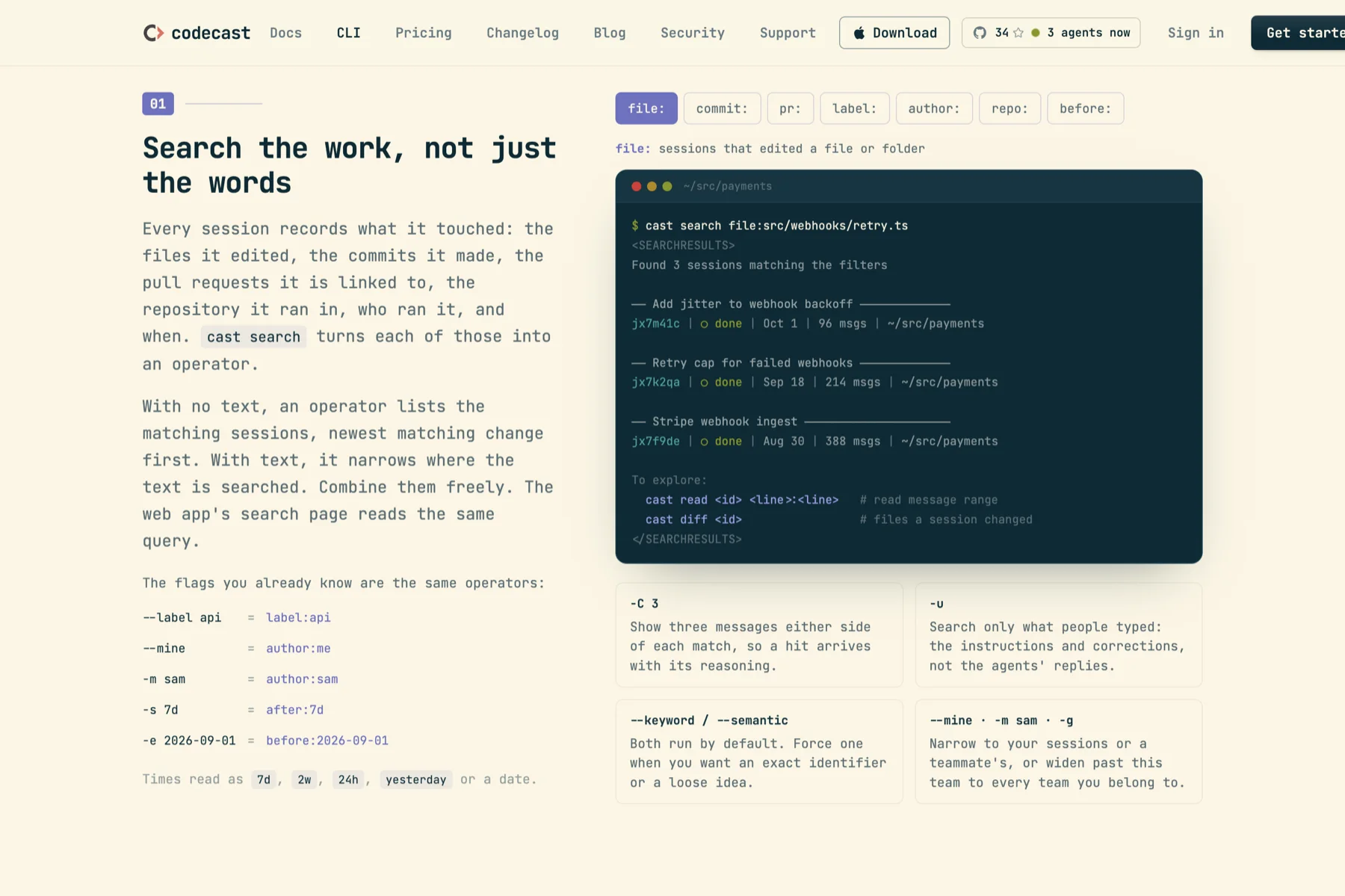
/features/memory page: the operators, and the familiar flags (--mine, -m sam, -s 7d) shown as aliases for them.Ask one session, get cited lines and the later reversal
A 300 message session is a lot to page through when you want one fact. cast read <id> --ask "<question>" answers from that one session. It leads with the direct answer, backs each point with the message numbers it rests on, and prints the cast read ranges to open them. A small model runs it on the server, and the footer prints the model, tokens and cost of each answer. A real run:
$ cast read jx7bbz2 --ask "why was the guide line dropped from the nav subsection?"
── Crosshatch refinement ───────────────────────────────────
   jx7bbz2 | 79 lines | why was the guide line dropped from the nav subsection?

The guide line was dropped because the human requested it: "i think we
don't need the left line" (msg 65). The agent then removed the vertical
border from the nested lists in the sidebar (msg 68, 72), compensating
by widening the indent by 1px to maintain the layout.

read: cast read jx7bbz2 65:68  cast read jx7bbz2 72
claude-haiku-4-5 · read 79 lines, 37 matched, showed 75 · 5.9k in / 196 out, $0.007 · 3.2s
The clever part is that it reads past the first relevant passage. People change their minds and agents try things that fail, so the first answer in a transcript is often wrong by the end. When a later message revised the answer, --ask gives you the later one and names the earlier one as history. A session too long to read whole is read end first, then start, and the answer names the stretch it skipped, since that stretch could change the answer. If the session does not hold the answer, it says so and points at the closest lines instead of guessing. With no id, cast read --ask asks the session you are in, past its own compactions, which is how an agent recovers what the user asked for in turn one after its context was summarized.
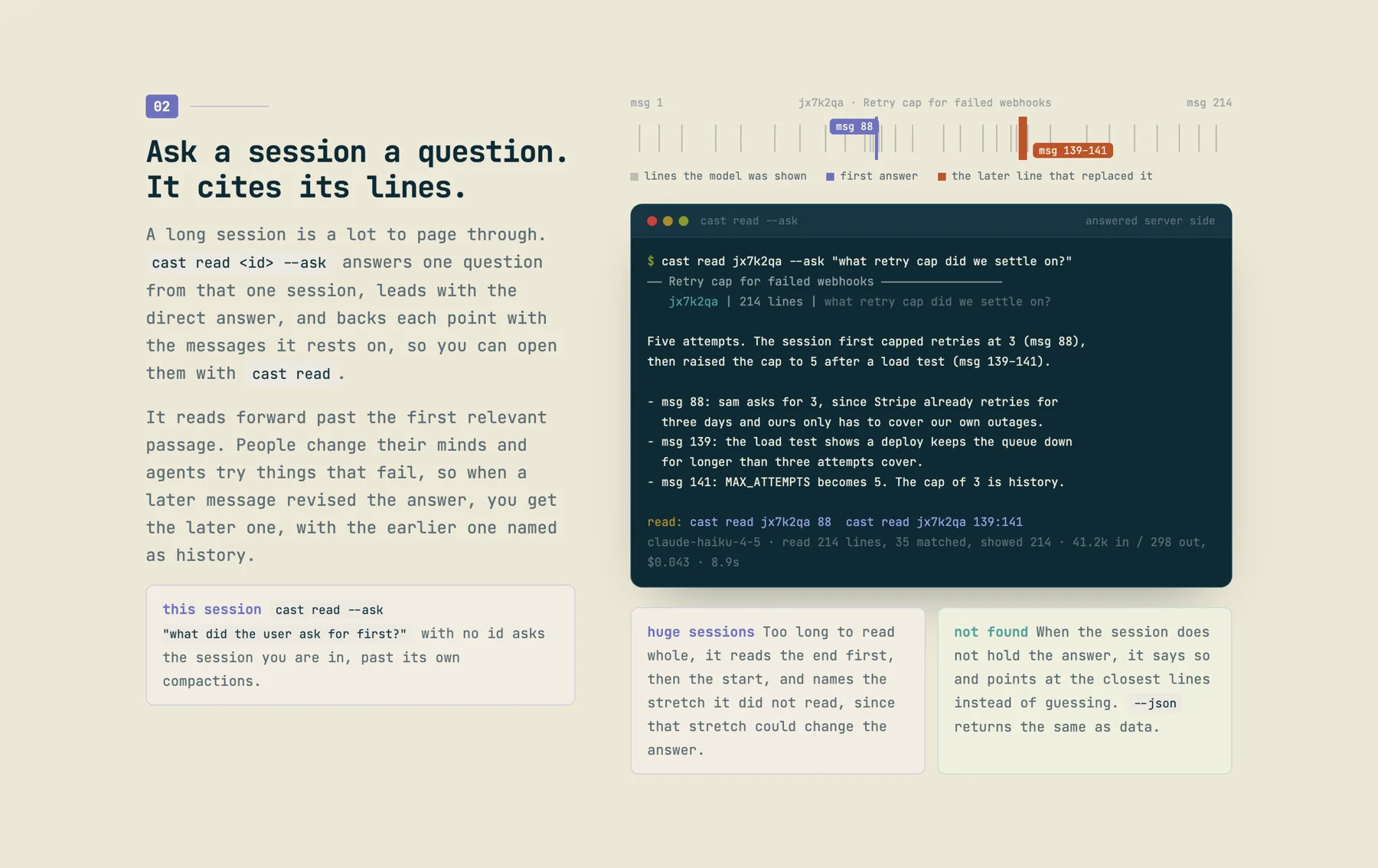
When agents write the code, git blame names whoever committed it, which tells you nothing about why. cast blame is a drop-in replacement: the same output format, but the author column shows the session that wrote each line, with its short id and title. Lines no session wrote keep their git author. Because the output matches git blame's default and porcelain formats (porcelain adds codecast-session, codecast-title, codecast-url and related keys), an editor integration that shells out to git blame can call cast blame instead. On codecast's own repo:
$ cast blame -L 41,46 packages/web/scripts/readme-shots.ts
497bc4e815 (jx781zf Ashot Documentation audit and refresh 2026-10-05 11:23:15 -0400 41) const OUT_DIR = join(import.meta.dir, "..", "..", "..", "docs", "screenshots");
497bc4e815 (jx781zf Ashot Documentation audit and refresh 2026-10-05 11:23:15 -0400 42) const OUT_WIDTH = 1920;
497bc4e815 (jx781zf Ashot Documentation audit and refresh 2026-10-05 11:23:15 -0400 43) const SETTLE_MS = 9000;
497bc4e815 (Ashot Petrosian                               2026-10-05 11:23:15 -0400 44)
497bc4e815 (jx781zf Ashot Documentation audit and refresh 2026-10-05 11:23:15 -0400 45) // Lift the film out of the page's column so it lays out at its native 1280x760
497bc4e815 (jx781zf Ashot Documentation audit and refresh 2026-10-05 11:23:15 -0400 46) // stage with no scale, then report where it sits in document coordinates.

$ cast blame --log packages/web/scripts/readme-shots.ts
Sessions that shaped ~/src/codecast/packages/web/scripts/readme-shots.ts  (82/98 lines attributed)

  jx781zf  Ashot   497bc4e81  Documentation audit and refresh             82 lines  2026-10-05

  <CR> opens the conversation · O opens the file at that session's commit (vim :Gslog)
  Newest: https://codecast.sh/conversation/jx781zf4kke2vawx9jkks2rcsx8fm4nw
Line 44 is blank, so no session is credited with it and it falls back to the git author. The attribution is per line, not per commit: a commit that mixes an agent's edits with a hand edit credits only the lines the session actually wrote. Blame also reaches uncommitted lines in the working tree: where git can only say Not Committed Yet, cast blame names the live session that wrote them when its edits were captured.
The rest of the family: cast blame --log lists the sessions that shaped a file, newest first; --open src/x.ts:42 resolves a line to its session and opens the conversation in the browser; --install-fugitive installs a shim so vim-fugitive's :Gblame shows sessions; --log --quickfix feeds a vim quickfix list.
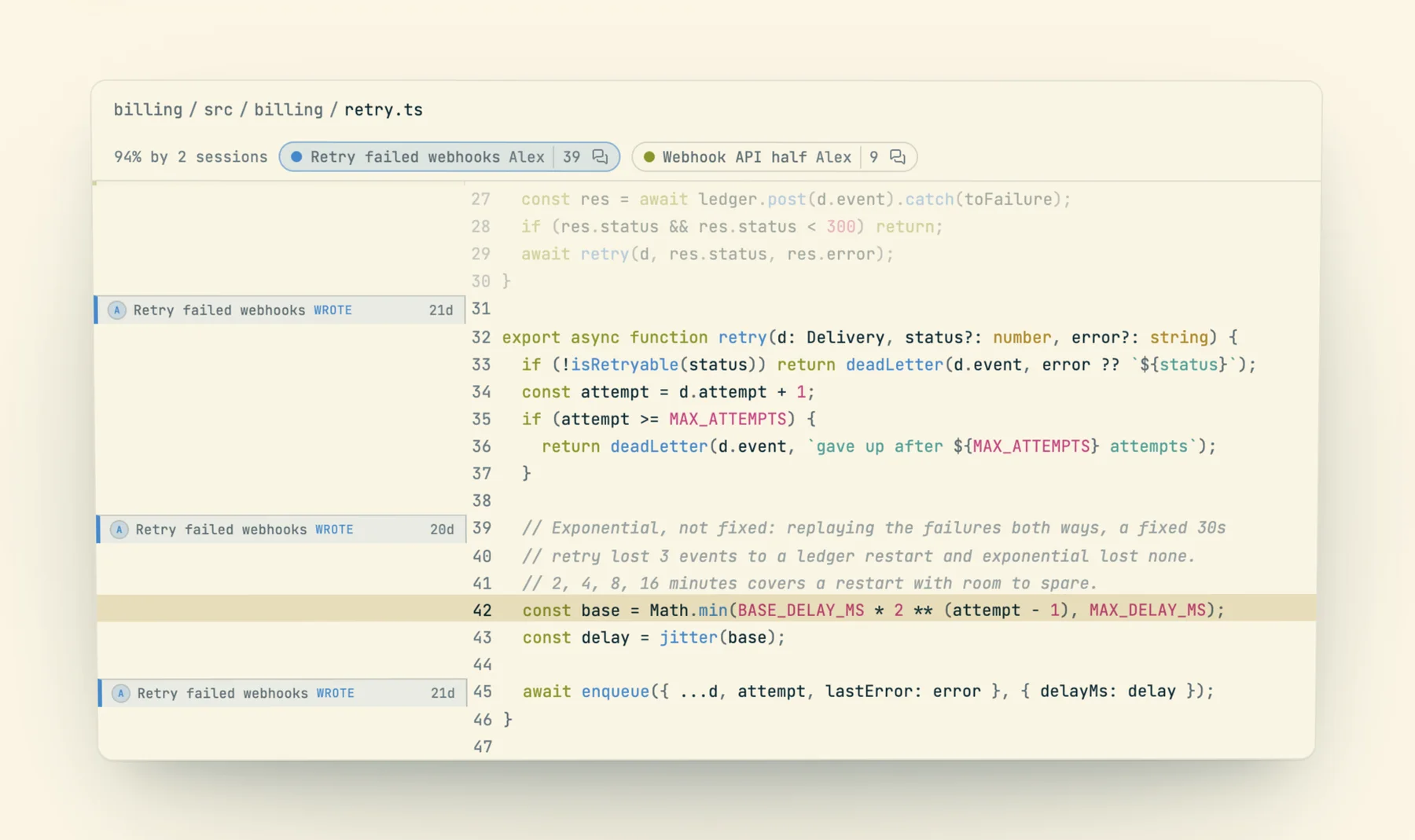
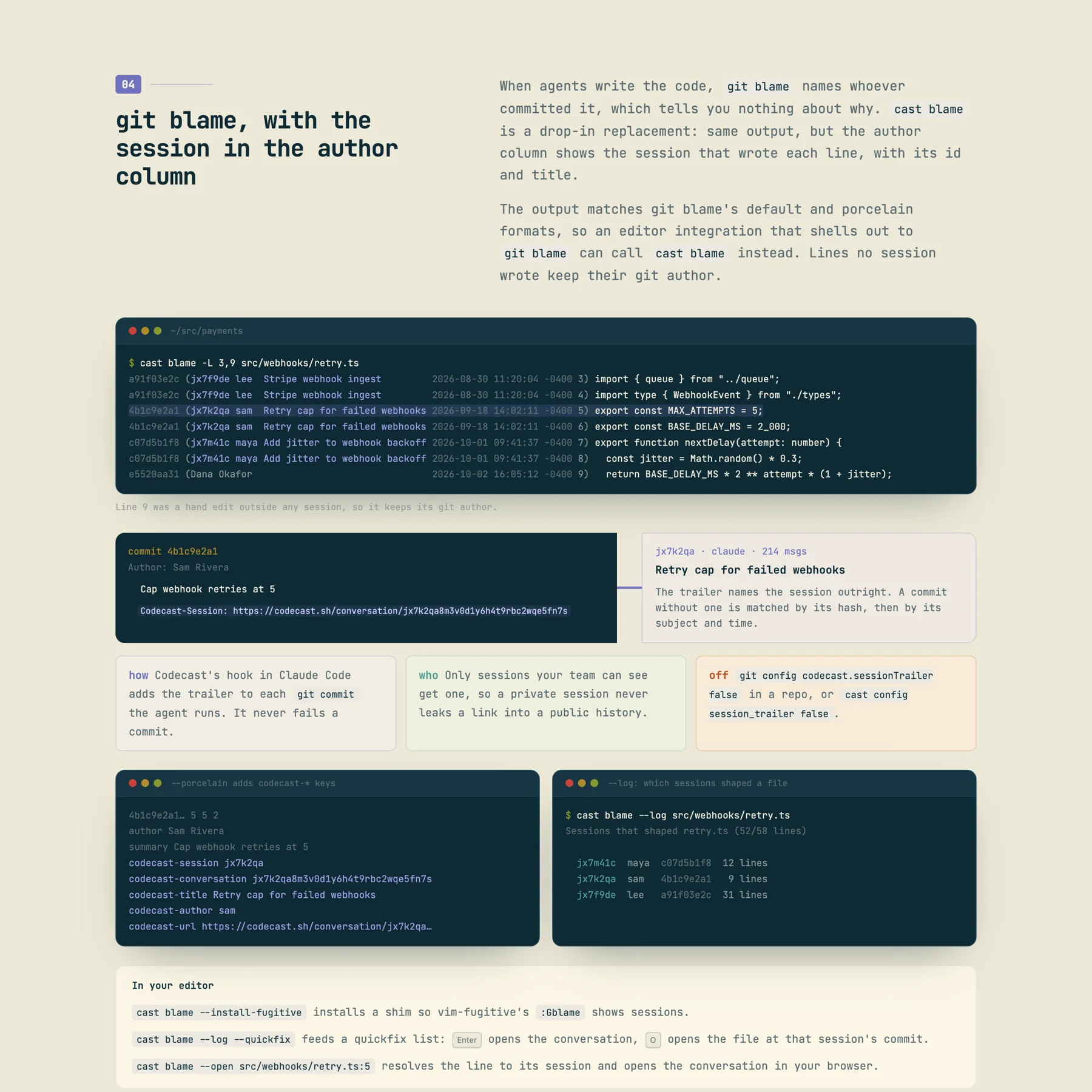
/features/memory: the commit carries a Codecast-Session: trailer, and porcelain output adds codecast-* keys for editors.The trailer: the commit names its session
How does blame know which session wrote a line? Codecast's hook in Claude Code appends a trailer to each git commit the agent runs:
$ git show -s 5831cb2e2
commit 5831cb2e2
Author: Ashot Petrosian

    web: subtler nav subsection crosshatch, drop the guide line

    Codecast-Session: https://codecast.sh/conversation/jx7bbz2kqg507dp2mnjk0heegx8fjht7
The trailer is the session's own word, so it beats every heuristic. Commits without one (other agents, hand commits, a commit made before codecast was installed) are matched by hash, then by subject and time. That fallback is good but not certain; the trailer is. Three guardrails: the hook never fails a commit; only sessions your team can see get a trailer, so a private session never leaks a link into a public history; and it can be turned off per repo with git config codecast.sessionTrailer false or everywhere with cast config session_trailer false. On codecast's pull request page the trailer renders as a session pill rather than a URL.
Other ways in
cast context "implement auth"orcast context --auto(reads your branch name and changed files): the sessions that already worked on what you are about to start, before the first message.cast ask "how does X work": from a question to passages across several sessions, each with its session and message range.cast diff <id>andcast summary <id>: what a session actually changed (files, commits, tools) and its goal, approach and outcome. A session's state says who is paying attention now, not what it did, so this is the check before crediting work to it.cast decisions add "title" --reason "why": conclusions that should not depend on anyone finding the right session, written to a log agents search before relitigating a choice.
Scope is the team's: sessions in a project shared with your team are searchable by the team, sessions in a private project only by you, and -g widens to every team you belong to, never past them. Message text is matched in full for the last 30 days; older sessions still surface by title and summary.