Pull requests that know their session
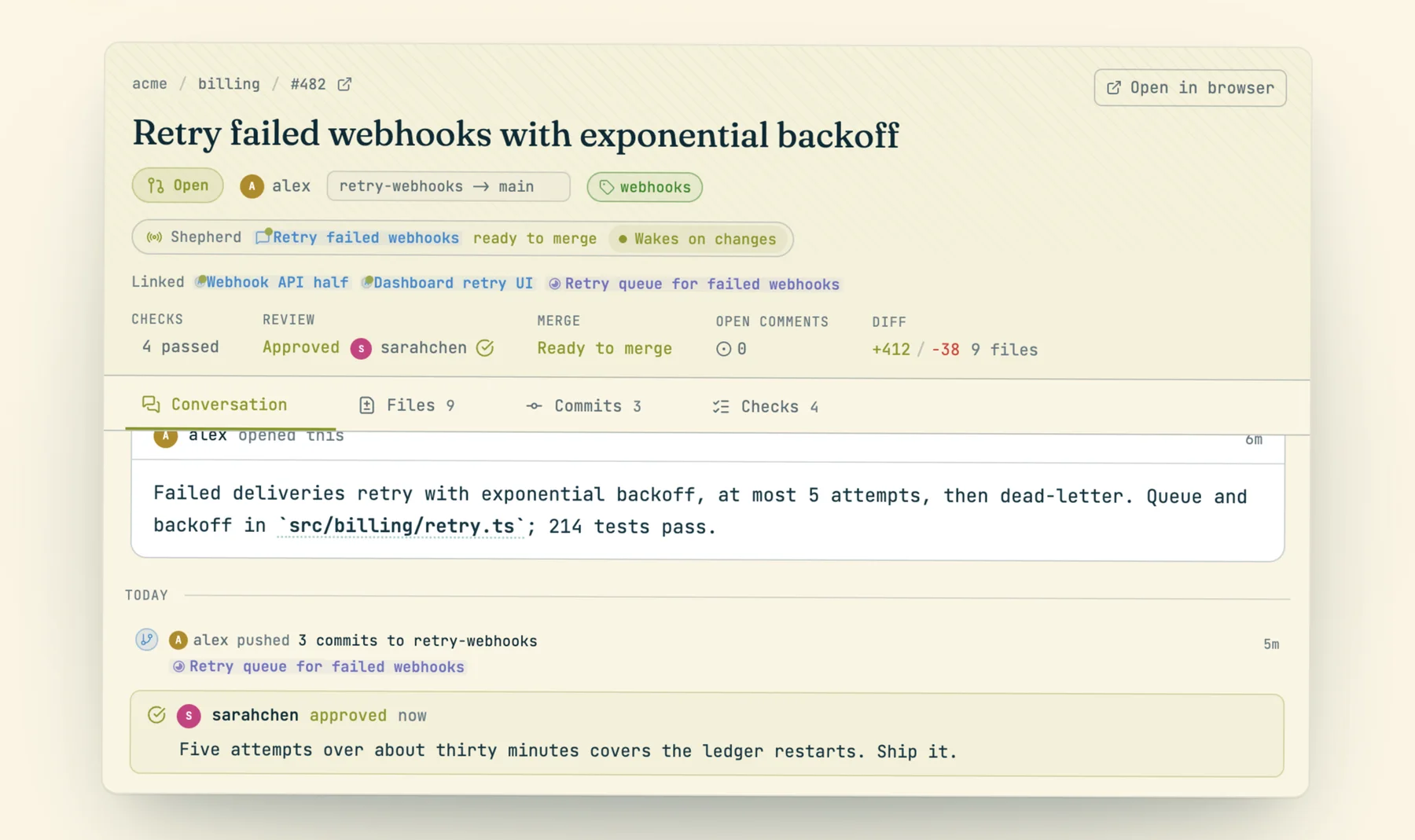
Every PR carries the sessions that made it, and a review, a red check or a conflict wakes the agent that owns it.
When an agent wrote the change, the reasoning lives in a transcript, not in the pull request description. And once the PR is open, the agent that wrote it is gone: a red check, a request for changes or a merge conflict waits for a human to notice, open a new session, explain the context again and ask for a fix. Codecast closes both gaps. Every pull request carries links to the sessions that made it, and one session can be bound to the PR as its shepherd, woken by GitHub events until the merge.
How a PR finds its sessions
Pull requests arrive through the codecast GitHub app, and a webhook is the only writer of the PR row: nothing you do in codecast writes it directly; every act goes to GitHub, and GitHub's webhook updates the row, so the two sides cannot disagree. Sessions are linked three ways:
- Sessions on the branch. When GitHub reports the PR opened, codecast links the sessions that worked on its head branch and picks the most recent one in that repository as the shepherd candidate. The candidate stays paused until you turn it on.
- A trailer on every agent commit. The
Codecast-Session:trailer (see team memory above) names each commit's session outright, and the Commits tab renders it as a session pill. - Task ids in the text. A task id like
ct-4102in the title, body or branch name links the task, and the shepherd's briefing lists it under linked work.
From the other side, cast search "pr:acme/api#214" returns every session behind a pull request, and cast blame attributes each line.
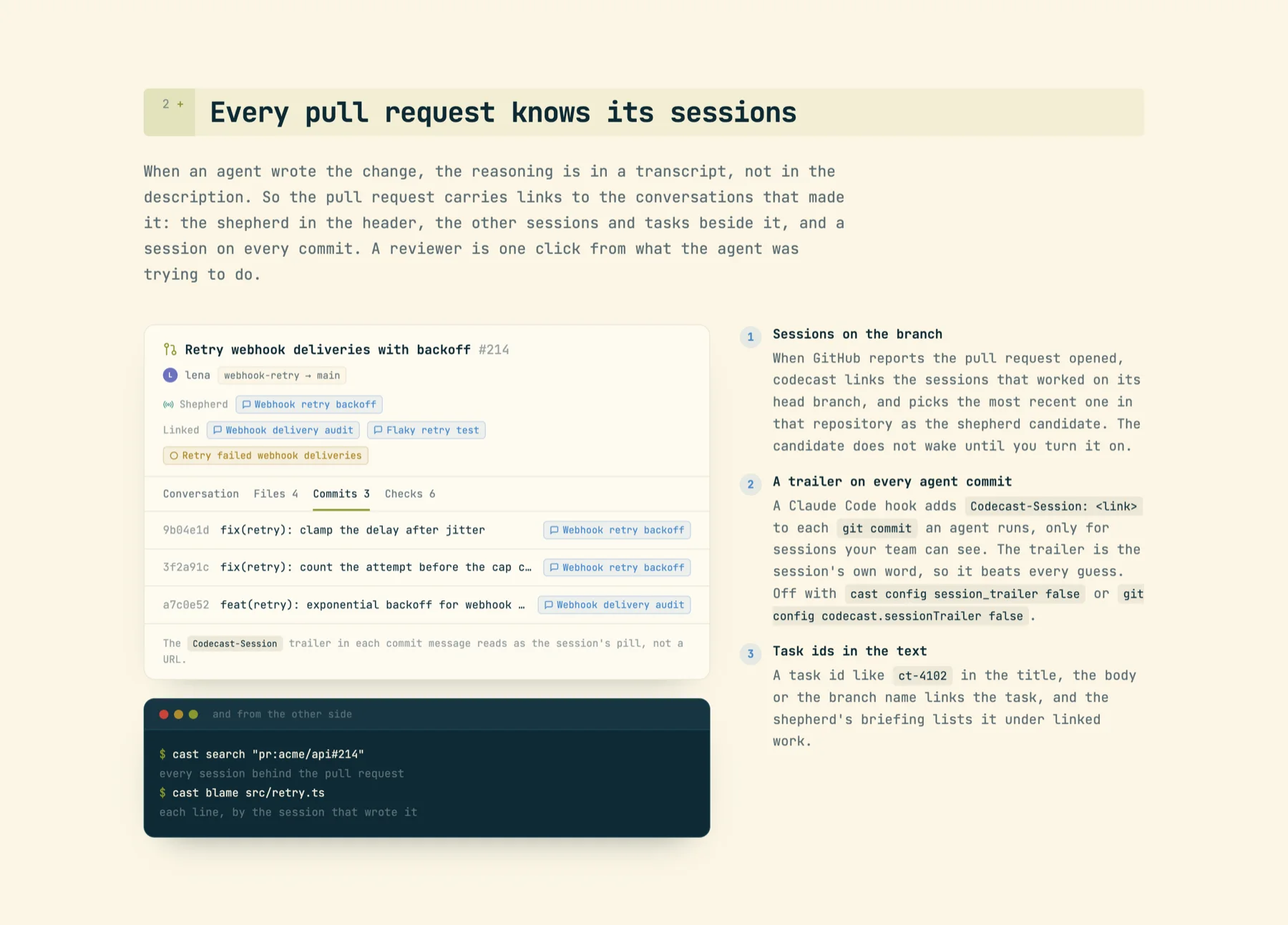
/features/pull-requests: each commit wears the pill of the session that made it.The shepherd
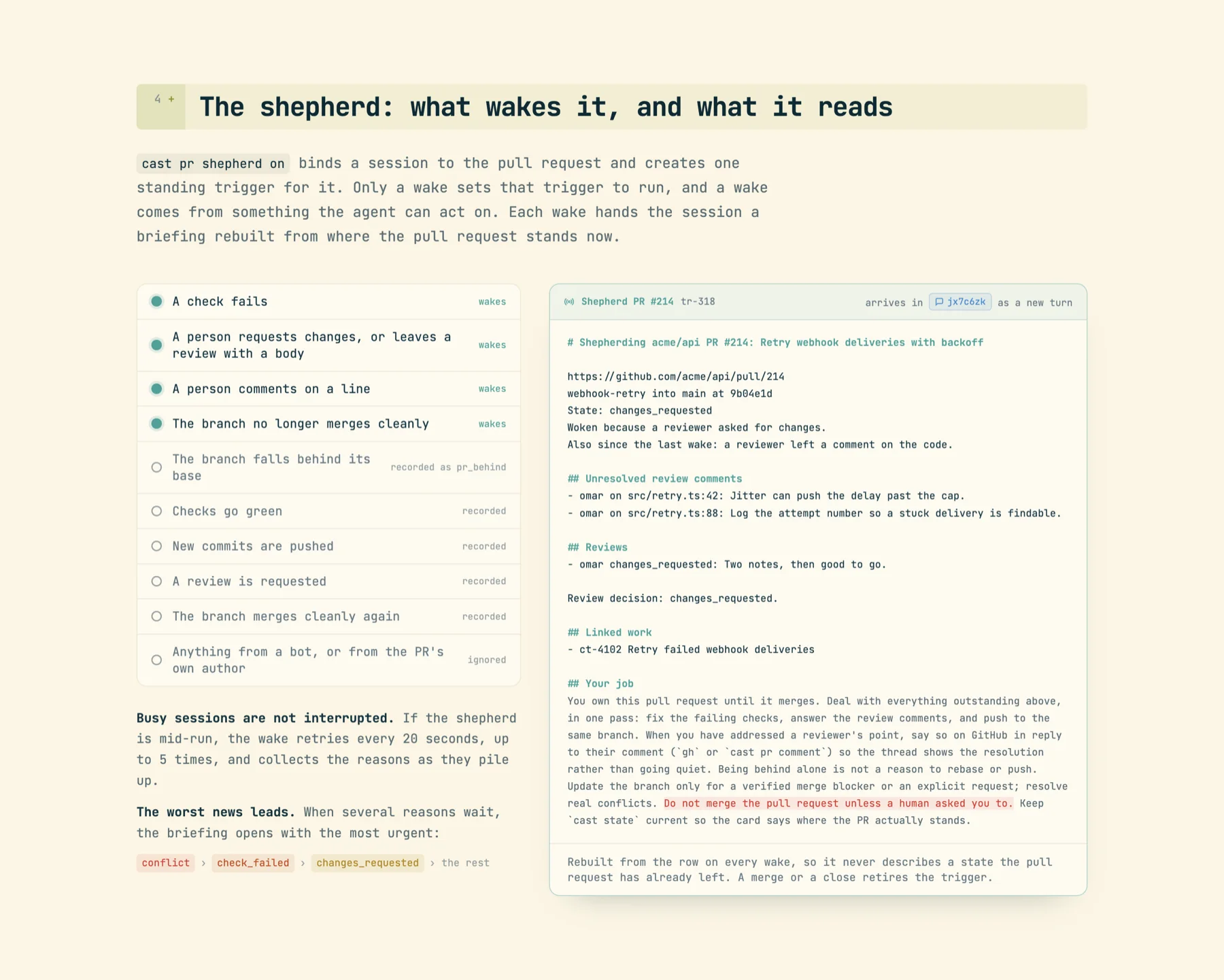
cast pr shepherd on binds the current session to a pull request (by number, owner/repo#n, URL, or nothing for the PR on your branch) and creates one standing trigger for it. Only a wake sets that trigger to run, and a wake comes from something the agent can act on:
| Event | Effect |
|---|---|
| A check fails | wakes |
| A person requests changes, or leaves a review with a body | wakes |
| A person comments on a line | wakes |
| The branch no longer merges cleanly | wakes |
| Branch falls behind its base; checks go green; new commits; a review is requested | recorded, no wake |
| Anything from a bot, or from the PR's own author | ignored |
Each wake hands the session a briefing rebuilt from where the pull request stands now, so it never describes a state the PR has already left. When several reasons pile up, the worst news leads (conflict, then a failed check, then changes requested). If the shepherd is mid-run, the wake does not interrupt it: it retries every 20 seconds, up to 5 times, collecting reasons as they arrive. The briefing tells the agent to fix the checks, answer the comments and push in one pass, to reply on each thread so it shows a resolution rather than going quiet, not to rebase merely because the branch is behind, and, in so many words, not to merge unless a human asked. A merge or close retires the trigger.
$ cast pr shepherd on
$ cast pr shepherd status
$ cast pr watch 482          # one line per change: shepherd state, checks, review, merge state
$ cast pr show 482           # checks, reviews, open threads, linked sessions, last events
$ cast pr shepherd off       # release it
The /cast-ship skill does the whole run from finished work: it commits in topical pieces, opens the PR with a description that links the session, and binds the session as shepherd, so the agent sleeps between events instead of polling. /cast-ship feedback skips straight to working the open threads once.
Held notes, sent as one review
Reviewing is a batch, not a drip. You hold a note on each line that needs one, from the Files view or the CLI, and held notes are yours alone: nobody else sees them, nothing reaches GitHub, and no session wakes. When you finish, they leave together as one GitHub review with one verdict, under your GitHub account (a verdict is a judgement, so it never goes out as the app). If a session owns the PR, the whole review reaches it as one message the moment GitHub accepts it, so the agent wakes once with every note in hand instead of once per comment.
$ cast pr comment 214 --hold --file src/retry.ts --line 42 "Jitter can push the delay past the cap."
ok held for your review of acme/api#214 (`cast pr notes` lists it, `cast pr review` sends the batch)

$ cast pr notes 214
acme/api#214  2 held notes
  q4c7b2xm  src/retry.ts:42  Jitter can push the delay past the cap.
  r81kd0ve  src/retry.ts:88  Log the attempt number so a stuck delivery is findable.

$ cast pr review 214 --request-changes -b "Two notes, then good to go."
ok requested changes on acme/api#214 with 2 notes as omar
  https://github.com/acme/api/pull/214#pullrequestreview-2841907733
  delivered to session jx7c6zk
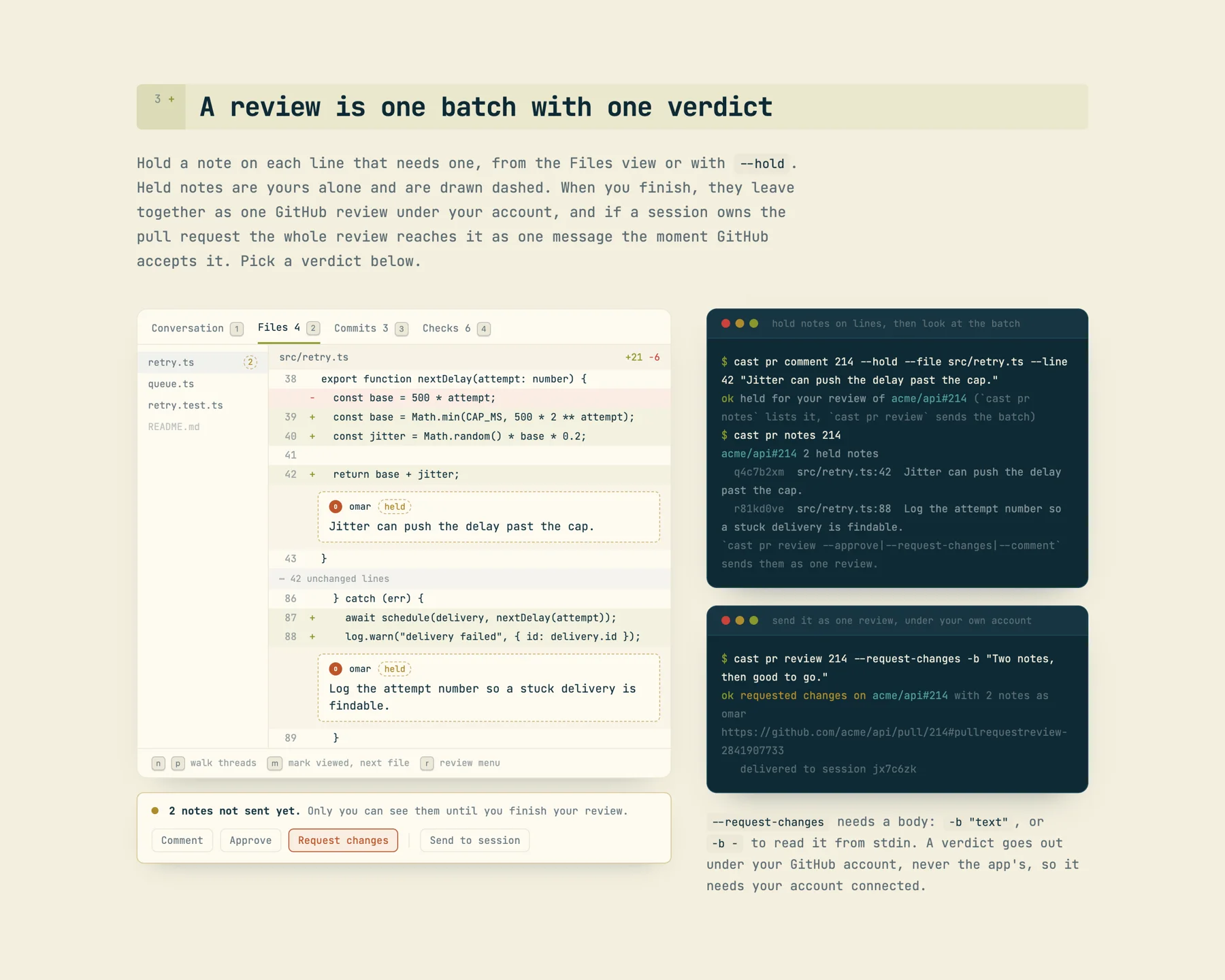
Some rules come straight from GitHub and are passed through verbatim: you cannot approve your own pull request, and --request-changes or --comment needs a body. Review text reaches the agent fenced, each note and the summary capped at 3,000 characters inside a delimiter naming its source. After fixing, the agent answers each thread with cast pr comment --reply <thread> and settles it with cast pr resolve <thread>, naming threads by the short id cast pr threads prints or by file:line.